
 EN
EN
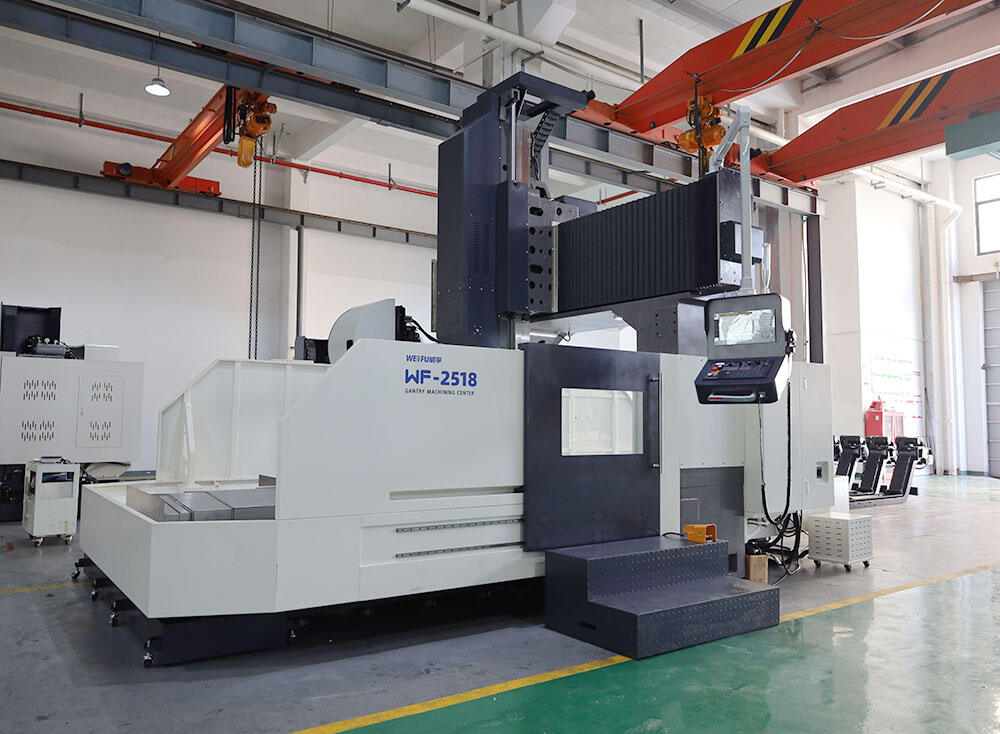
Structural Rigidity: The Foundation of Precision in Gantry Machining Center
Double-column architecture and monolithic base design minimizing thermal and dynamic deflection
The double-column configuration provides symmetric force distribution, routing cutting stresses directly into the machine foundation. Paired with a monolithic mineral cast base—offering a damping coefficient 10× higher than conventional cast iron—this design limits thermal drift to <0.5 µm/m·°C. During titanium milling at 80% spindle load, measured deflection was 40% lower than single-column alternatives. This level of rigidity is essential for maintaining dimensional integrity across extended 8-hour aerospace machining cycles.
Vibration damping systems and FEA-optimized castings enabling ≤2 µm positioning accuracy at full load
Passive damping networks—filled with high-viscosity polymers—suppress resonant frequencies above 300 Hz, preventing chatter during high-RPM carbide tooling (e.g., 18,000 RPM). Castings feature ribbing patterns optimized via Finite Element Analysis to elevate natural frequencies beyond typical servo bandwidths (100–150 Hz), ensuring stability during demanding operations like deep slotting. Validated per ASME B5.64, these systems deliver ≤2 µm positioning repeatability—even under 50 kW roughing loads in hardened D2 steel.
Scalable Workpiece Capacity: Handling Extreme Sizes and Weights with a Gantry Machining Center
12m × 4m × 4m work envelope and 50+ ton payload supporting single-setup machining of wind turbine housings and EV battery molds
Gantry machining centers uniquely address the limitations of vertical and horizontal platforms when handling oversized components. With a 12m × 4m × 4m work envelope and 50+ ton payload capacity, they support uninterrupted machining of aerospace wing sections, marine propulsion housings, wind turbine gearboxes, and EV battery molds—all in a single setup. The stationary workpiece design preserves positional fidelity during high-force operations such as face milling hardened steel at 80 kW. Eliminating repositioning prevents cumulative tolerance stack-up—critical for hydraulic sealing surfaces and die-casting coolant channels. As confirmed by ASME B5.54-2023, this scalability reduces fixture costs by 65% for oversized parts while achieving ±0.05 mm flatness across 10-meter spans.
High-Efficiency Material Removal: Spindle Power and Thermal Management in Heavy-Duty Milling
ISO 50 spindle interface, 40–80 kW power, and sustained >120 cm³/min MRR in Inconel and hardened steel
High material removal rates in difficult alloys like Inconel and hardened steel demand more than raw spindle power—they require torque-rich performance and intelligent thermal management. Gantry machining centers equipped with ISO 50 spindles and 40–80 kW motors sustain metal removal rates exceeding 120 cm³/min in these materials. To avoid motor stalling and thermal overload during aggressive roughing, best practice recommends limiting spindle utilization to 70–80% of rated power—enabling consistent torque delivery for deep, stable cuts.
Multi-Axis Versatility and Process Integration: Expanding Capabilities Without Compromise
Simultaneous 5‑axis contouring for aerospace ribs and semiconductor flanges—maintaining rigidity under complex toolpaths
The gantry’s double-column architecture and reinforced castings provide structural stability during simultaneous 5-axis contouring—essential for thin-walled aerospace ribs and precision semiconductor flanges. This rigidity suppresses vibration and deflection across complex, high-acceleration toolpaths, preserving surface finish, dimensional accuracy, and cutting speed without compromise.
Integrated milling, drilling, boring, and tapping reducing cycle time by up to 37% (MTConnect‑verified) in large‑part production
By consolidating milling, drilling, boring, and tapping into a single setup, gantry machining centers eliminate multiple transfers and re-fixturing—cutting total processing time by up to 37%, as verified by MTConnect telemetry. This integration accelerates throughput, lowers labor requirements, and enhances part quality through reduced handling-induced error—all within a unified, high-rigidity platform.
Partner with Weifu CNC for Custom Gantry Machining Center Solutions
As a trusted 20-year Chinese CNC machine manufacturer & OEM supplier, Wuxi Weifu International Trade Co., Ltd. delivers high-performance gantry machining centers tailored to your unique heavy-duty manufacturing needs. Our precision-engineered equipment meets global quality standards (ASME, ISO) and serves core industries including aerospace, new energy, marine engineering, and heavy machinery.
Whether you need standard gantry machining centers, customized configurations, or turnkey machining solutions, our professional engineering team provides end-to-end support—from technical consultation and design customization to manufacturing, global delivery, and 12-month reliable after-sales service. We adhere to strict quality control protocols, offer rapid customization capabilities, and ensure consistent product reliability to help you boost production efficiency, cut operational costs, and strengthen your competitiveness in the global market.
Ready to upgrade your heavy-duty machining capabilities? Contact our international sales team today for a free technical quote, detailed product catalog, or one-on-one customized solution consultation. Let’s build a long-term OEM/ODM partnership and drive your manufacturing success together!
FAQ
What is the advantage of a monolithic base design in gantry machining centers?
The monolithic base design offers enhanced damping and rigidity, reducing thermal drift and dynamic deflection during machining operations. This ensures higher accuracy and precision over extended machining cycles.
How does vibration damping improve machining accuracy?
Passive damping systems suppress resonant frequencies, minimizing chatter and vibration during high-speed machining. This leads to better surface finish and positional accuracy, even under heavy loads.
What types of workpieces are ideal for gantry machining centers?
Gantry machining centers are perfect for oversized components like aerospace wing sections, wind turbine housings, and EV battery molds. Their scalability and load capacity enable single-setup machining of large and heavy components.
How is cycle time reduced in gantry machining centers?
By integrating multiple processes, such as milling, drilling, boring, and tapping, into one setup, gantry machining centers minimize re-fixturing and transfers. This significantly reduces processing time and improves part quality.
Table of Contents
- Structural Rigidity: The Foundation of Precision in Gantry Machining Center
- Scalable Workpiece Capacity: Handling Extreme Sizes and Weights with a Gantry Machining Center
- High-Efficiency Material Removal: Spindle Power and Thermal Management in Heavy-Duty Milling
- Multi-Axis Versatility and Process Integration: Expanding Capabilities Without Compromise
- Partner with Weifu CNC for Custom Gantry Machining Center Solutions
- FAQ

