
 EN
EN

What Makes a Cylindrical Grinder Essential for Precision Manufacturing
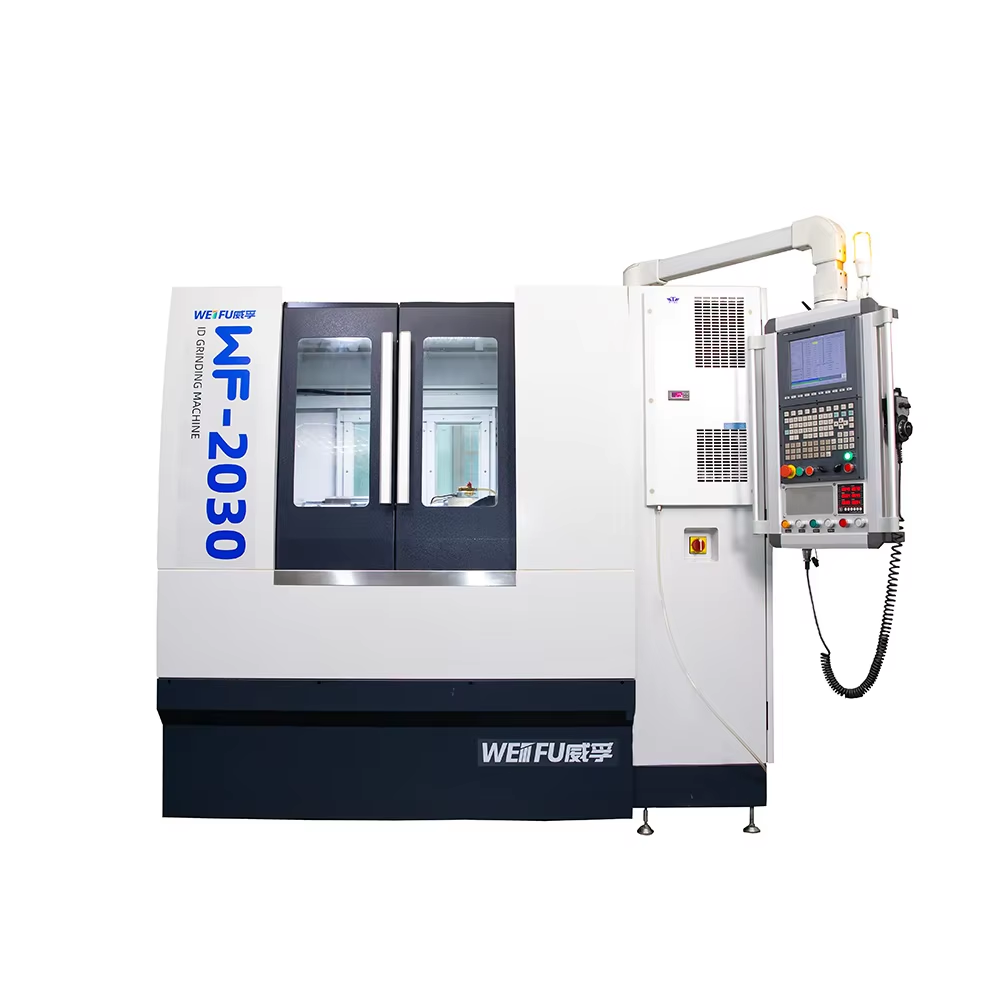
Cylindrical grinders are pretty much the gold standard when it comes to getting those perfect shapes on rotating parts such as shafts, bearings, and hydraulic pistons. These machines can hit tolerances tighter than 2 microns, which means parts actually fit together properly in industries where even tiny deviations matter a lot, like aircraft engines, surgical instruments, and wind turbine components. The single clamping process really cuts down on mistakes because there's no need to reposition parts midway through. Cycle times drop around 40% compared to older methods, and concentricity stays rock solid at less than half a micron throughout. What sets these grinders apart is how they handle different materials. From toughened steel to ceramic coatings and carbon fiber composites, manufacturers don't have to switch between dozens of specialized tools anymore. This saves money on both tool inventory and factory floor space. Top shops now integrate smart sensors that constantly monitor what's happening during grinding while adjusting coolant flow automatically based on temperature changes. When all these factors come together - consistent results, wide material compatibility, and faster production - it's no wonder so many companies rely on cylindrical grinding for their most valuable products.
Achieving Sub-Micron Tolerances: Precision Capabilities of Modern Cylindrical Grinders
Roundness, cylindricity, and diameter control under optimal setup
Modern cylindrical grinders achieve remarkable geometric precision. Under optimal conditions, they maintain:
- Roundness within 0.00005" (1.27 µm)
- Cylindricity below 0.0001" (2.54 µm)
- Diameter consistency of ±0.00005" (±1.27 µm)
This precision stems from rigid machine construction, high-resolution encoders, and temperature-controlled environments. Proper wheel selection and dressing techniques further enhance accuracy. For example, fine-grained CBN wheels produce superior surface finishes below Ra 0.1 µm while maintaining dimensional stability.
Why tighter tolerances don’t always require higher-cost machines
Properly maintained mid-range cylindrical grinders can match premium models when implementing these techniques. A 2023 study by the National Institute of Standards and Technology (NIST) found that 78% of surveyed manufacturers achieved aerospace-grade tolerances (±5 µm) without machine upgrades through process refinements alone.
Surface Finish Performance: Ra, Rz, and Real-World Limits on a Cylindrical Grinder
How abrasive selection, coolant strategy, and feed rates shape finish quality
Getting the right surface roughness levels, measured by Ra values (average roughness) and Rz readings (how high and low the surface goes), depends on getting three main things right. The size of the abrasive grit makes a big difference in the finish quality. When working with materials like aluminum oxide or cubic boron nitride, smaller grain sizes tend to produce much smoother surfaces overall. Coolant plays another critical role too. Proper concentrations and pressure help keep heat from warping parts during machining while clearing away metal chips effectively. Most shops find around 8 to 10 percent synthetic coolant works best for most applications. Slowing down feed rates to under 0.005 mm per revolution also helps because it reduces cutting force and cuts down on vibrations that create uneven spots. Looking at what's happening in the industry, standard cylindrical grinders can usually hit Ra ranges between 0.1 and 0.8 micrometers when working with various steel types. But achieving those super smooth finishes below 0.05 micrometers takes really tight control over all these variables. Getting this balance right saves time in production runs while still hitting those tough specs required for aerospace components or medical devices where precision matters most.
Case insight: Aerospace shaft finishing at Wuxi Weifu using high-precision cylindrical grinders
An aerospace parts maker recently showed how effective cylindrical grinding can be in making turbine shafts. They switched to CBN wheels with 320 grit and added those high pressure coolant nozzles everywhere, which cut their average Rz values down around 40% compared to old school methods. The team fine tuned everything right down to the last decimal point: cutting depth at 0.15mm and feed rate just 0.003mm per revolution got them those super smooth Ra 0.08 microns surfaces consistently. What really matters though is that this level of precision means parts go straight into assembly without needing extra polishing steps, saving about a quarter of the total processing time. These kinds of improvements prove why cylindrical grinding works so well as a one step finish solution for critical components, especially when shops keep tight control over temperature changes and maintain solid work holding throughout the process.
Critical Enablers: Workholding and Process Control for Consistent Cylindrical Grinder Output
Comparing chucks, collets, and centerless setups for minimal runout
Getting the right workholding solution makes all the difference in cylindrical grinding accuracy. Chucks can handle odd shapes pretty well, though they need careful alignment to get runout under 5 microns. Hardened steel collets are another option, keeping things concentric within about 2 to 3 microns for regular sized parts. Then there's centerless grinding which does away with chucks altogether. These systems use regulating wheels to guide the workpiece through the process, making them great for mass production where tolerances need to be around plus or minus 0.001 mm. The advantage here is no deformation happens to those long, skinny parts like hydraulic rods, and setup takes roughly 30% less time than older methods. When it comes down to it, each system has its own strengths regarding rigidity versus ease of access. Collets tend to perform best when roundness matters most, whereas centerless setups help reduce vibrations in those tricky long, thin walled components. Always think about what shape the part actually is and how many pieces need to be made before picking a system. Getting this wrong could lead to runout over 10 microns even if someone spends extra money on top quality abrasives.
Thermal drift mitigation and in-process metrology integration
When grinding operations run for long periods, temperature changes can create serious problems with thermal expansion, sometimes reaching over 15 micrometers per meter. Modern machines fight back against these issues by incorporating coolant chillers that keep temperatures stable within half a degree Celsius, plus thermal sensors built right into the system which automatically adjust wheel positions when needed. Real time measurement is really important here too. Laser probes attached to the grinding carriage actually detect diameter changes as small as 0.1 micrometer while the machine is running, so adjustments happen before any parts get scrapped. For example, in making aerospace turbine shafts, companies have seen a drop of about 22% in dimensional rework simply because these systems catch thermal drift almost instantly. When predictive software works together with closed loop feedback systems, it keeps overall tolerances under 3 micrometers, which matters a lot when trying to achieve those super smooth Ra 0.2 micrometer surface finishes. And don't forget to check if the environmental controls in place actually match what the manufacturer says about thermal growth coefficients in their specs according to ISO 230-3 from 2022.
FAQ
What is a cylindrical grinder used for?
Cylindrical grinders are used to achieve precision shapes and tight tolerances on rotating parts such as shafts, bearings, and pistons in industries where even small deviations are crucial.
How does a cylindrical grinder maintain precision consistency?
Cylindrical grinders maintain precision through rigid construction, high-resolution encoders, temperature-controlled environments, and real-time monitoring systems.
Can mid-range cylindrical grinders match premium models in precision?
Yes, with proper process optimization and maintenance, mid-range cylindrical grinders can achieve similar precision levels as premium models.
How do modern machines address thermal drift?
Modern cylindrical grinders use coolant chillers, thermal sensors, and real-time measuring systems to control thermal drift and maintain accuracy.
Table of Contents
- What Makes a Cylindrical Grinder Essential for Precision Manufacturing
- Achieving Sub-Micron Tolerances: Precision Capabilities of Modern Cylindrical Grinders
- Surface Finish Performance: Ra, Rz, and Real-World Limits on a Cylindrical Grinder
- Critical Enablers: Workholding and Process Control for Consistent Cylindrical Grinder Output
- FAQ

