
 EN
EN
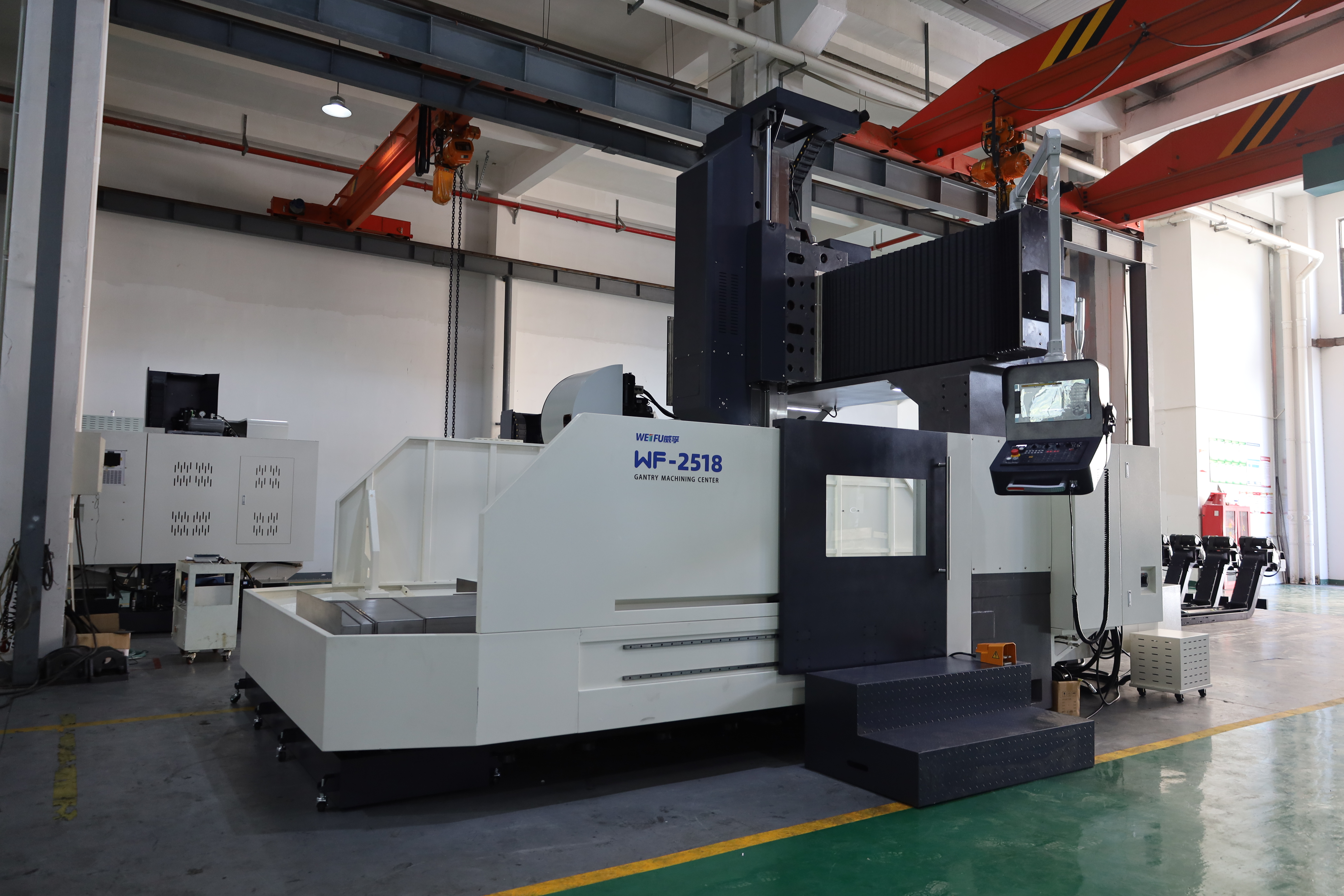
Why Gantry Machining Centers Are Essential for High-Precision Mold and Die Production
Micron-level accuracy and thermal stability under prolonged heavy-duty cutting
Achieving micron-level tolerances in mold and die production demands exceptional thermal stability—and the gantry machining center is uniquely engineered for it. Its massive, bridge-like structure distributes cutting forces evenly across the frame, preventing localized heat buildup that plagues cantilevered or C-frame machines. This symmetrical design inherently minimizes thermal displacement along all three linear axes, maintaining spindle-to-workpiece alignment even during hours of continuous heavy-duty cutting in hardened tool steels. Many high-end models further enhance this stability with active thermal compensation systems: embedded sensors monitor real-time temperature shifts in critical structural zones and automatically adjust axis positions to preserve dimensional integrity. For high-performance mold applications—especially large-scale dies requiring sub-10µm repeatability across multi-meter surfaces—this fusion of passive rigidity and intelligent thermal management is non-negotiable. It directly reduces scrap and rework, lowering per-part costs over long production runs.
Structural rigidity and vibration damping: Foundations for consistent surface finish and tight tolerances
The double-column, fixed-beam architecture of a gantry machining center delivers unmatched structural rigidity—fundamental to holding tight geometric tolerances and achieving Class-A surface finishes on large mold components. By supporting the spindle head from both ends, the gantry resists deflection far more effectively than single-column or moving-beam alternatives. This rigidity is amplified by a heavy cast-iron bed and reinforced crossbeam, which act as a high-mass damper to absorb and dissipate vibrations generated during interrupted cuts—common when machining hardened steel cavities or intricate core features. The result is exceptional positional repeatability (often within ±5µm over a 3-meter worktable) and dramatically reduced chatter, enabling smoother surface finishes that frequently eliminate secondary hand polishing. For mold makers, this consistency translates into tighter GD&T compliance, extended tool life, and more accurate blanks for downstream processes like EDM or electrode machining. In high-volume automotive die production, it saves hours of manual finishing per cavity—not as an efficiency bonus, but as a foundational requirement for precision at scale.
5-Axis Simultaneous Machining: Streamlining Complex Mold Fabrication with a Single Gantry Machining Center
Integrated large-diameter rotary tables and tilt-rotary heads for seamless multi-face machining
Modern gantry machining centers equipped with large-diameter rotary tables and high-torque tilt-rotary heads enable true 5-axis simultaneous motion—transforming how complex molds are fabricated. Unlike 3+2 positioning, this configuration allows continuous, coordinated movement across all five axes within a single program, letting the tool approach steep walls, deep cavities, and intricate undercuts from optimal angles without interruption. Keeping the tool perpendicular to the surface at all times minimizes deflection, supports shorter, stiffer tooling, and significantly reduces chatter—resulting in superior surface integrity and finer finishes. The integrated rotary table maintains high positional accuracy even under heavy loads and high torque, making it ideal for large, asymmetric mold components. This capability is essential for injection molds with conformal cooling channels or stamping dies with compound radii and tight-tolerance draft angles—enabling full contour machining in one setup where traditional methods would require multiple fixtures or secondary operations.
Eliminating repositioning errors and reducing setup time through single-setup mold finishing
A single gantry machining center performing full 5-axis finishing eliminates the need to transfer molds between machines or re-clamp for different operations. Every surface—roughed, semi-finished, and finished—is machined in one uninterrupted cycle with zero re-fixturing. This removes cumulative positioning errors that inevitably occur each time a part is re-aligned, directly improving dimensional consistency across all features and simplifying first-article inspection. Setup time drops substantially: operators no longer spend minutes—or hours—zeroing, probing, and verifying alignment on secondary machines. For high-value molds, it also reduces handling risk and potential damage during transfer. When paired with advanced CAM software that optimizes continuous tool paths for minimal acceleration changes and constant chip load, this workflow delivers measurable gains in throughput, precision, and cost control—making the gantry machining center not just a production tool, but a strategic enabler of complex mold fabrication.
Real-World Impact: Automotive and Aerospace Mold Manufacturing with Gantry Machining Centers
High-volume production of Class-A automotive body panels and structural dies
In both automotive and aerospace manufacturing, the gantry machining center serves as the cornerstone of high-precision, high-volume mold and die production. For Class-A automotive body panels—including hoods, doors, and fenders—these machines deliver the micron-level accuracy and surface fidelity required for flawless paint-ready finishes. Their rigid, thermally stable construction enables aggressive machining of hardened tool steels (e.g., H13 or S7) while sustaining tight tolerances over millions of stamping cycles. In aerospace, gantry machining centers produce large structural dies for monolithic components such as wing ribs and fuselage frames—reducing part count, assembly complexity, and weight. By handling oversized workpieces in a single clamping, they eliminate repositioning errors and ensure uniform quality across long production runs. This capability directly shortens lead times, improves yield, and lowers cost per part—proving indispensable for manufacturers balancing precision, scale, and reliability.
Selecting the Right Gantry Machining Center: Matching Specifications to Mold and Die Requirements
Selecting the optimal gantry machining center requires aligning technical specifications with your mold and die application’s physical and precision demands. Workpiece size and weight dictate minimum table dimensions, travel ranges, and load-bearing capacity—especially critical for large automotive dies or aerospace tooling. Structural rigidity is paramount: fixed-beam configurations offer superior stability for heavy-duty cutting, reducing vibration and preserving micron-level accuracy in complex cavities. Thermal stability systems—whether passive (low-CTE materials, symmetrical cooling) or active (real-time sensor feedback)—are essential for long-cycle operations to prevent dimensional drift. Spindle power (25+ HP recommended for hardened steels) and low-end torque delivery must support aggressive roughing without stalling. For multi-sided machining, integrated rotary tables or tilt-rotary heads significantly reduce repositioning errors and simplify programming. Axis acceleration (≥ 1.0 m/s²) and rapid traverse speeds (≥ 30 m/min) further enhance productivity on large parts without sacrificing surface quality. Industry studies indicate fixed-beam configurations provide up to 30% greater rigidity than moving alternatives [Hirung 2025], reinforcing their suitability for high-tolerance aerospace tooling—where precision isn’t incremental, it’s foundational.
FAQs
What is a gantry machining center?
A gantry machining center is a type of CNC machine with a bridge-like structure designed for high-precision milling, particularly for mold and die production. It features exceptional thermal stability, structural rigidity, and the ability to handle large workpieces.
Why is thermal stability important in gantry machining centers?
Thermal stability ensures precise machining by minimizing thermal displacement, maintaining spindle-to-workpiece alignment during prolonged cutting operations. This reduces dimensional inaccuracies and prevents defects in molds and dies.
What are the benefits of 5-axis simultaneous machining in mold production?
5-axis simultaneous machining enables uninterrupted multi-surface machining, reduces repositioning errors, and ensures faster setup times. It improves dimensional accuracy, surface finishes, and overall workflow efficiency.
How does structural rigidity contribute to mold and die production?
Structural rigidity minimizes deflection and vibration during machining, ensuring tight tolerances and high-quality surface finishes. This improves tool life, reduces manual finishing, and enhances geometric accuracy.
What factors should be considered when selecting a gantry machining center?
Key factors include workpiece size, table dimensions, load-bearing capacity, thermal stability systems, spindle power, integrated rotary tables, axis acceleration, and rapid traverse speeds.
Table of Contents
- Why Gantry Machining Centers Are Essential for High-Precision Mold and Die Production
- 5-Axis Simultaneous Machining: Streamlining Complex Mold Fabrication with a Single Gantry Machining Center
- Real-World Impact: Automotive and Aerospace Mold Manufacturing with Gantry Machining Centers
- Selecting the Right Gantry Machining Center: Matching Specifications to Mold and Die Requirements
-
FAQs
- What is a gantry machining center?
- Why is thermal stability important in gantry machining centers?
- What are the benefits of 5-axis simultaneous machining in mold production?
- How does structural rigidity contribute to mold and die production?
- What factors should be considered when selecting a gantry machining center?

