
 EN
EN
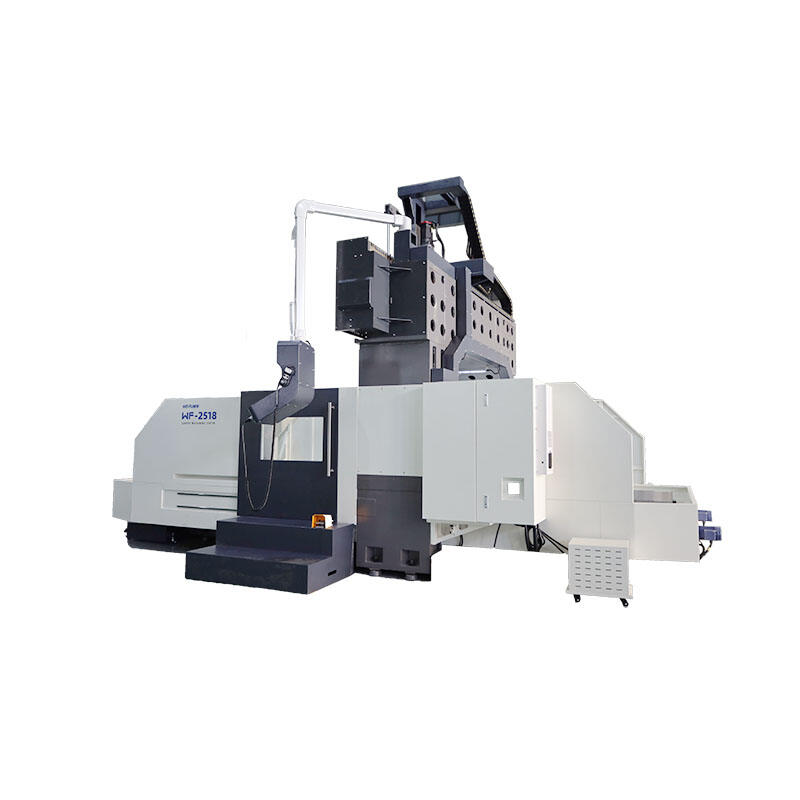
Why Gantry Machining Centers Are Driving Smart Manufacturing Adoption
Structural Advantages: Rigidity, Scalability, and Precision for Large-Part Production
Gantry machining centers deliver unmatched structural rigidity through their bridge-style framework—distributing loads across dual columns and a rigid crossbeam. This design minimizes deflection and vibration during heavy cutting, enabling precision machining of oversized components like aerospace frames and wind turbine hubs. Unlike vertical machining centers, where cantilevered tooling introduces cumulative error, gantry systems maintain geometric stability across meter-long travel spans. Scalability is built-in: modular rail extensions allow manufacturers to increase work envelope size without sacrificing positional accuracy—achieving tolerances within ±0.01 mm over 3-meter axes. In high-value sectors where rework averages $740k per incident (Ponemon Institute, 2023), this consistency directly mitigates risk and supports first-pass success.
Industry 4.0 Readiness: Native compatibility with IoT, MES, and digital infrastructure
Gantry machining centers ship with native Industry 4.0 capabilities—including OPC UA-compliant interfaces, embedded Ethernet/IP ports, and RESTful APIs—enabling plug-and-play integration with IoT sensor networks, Manufacturing Execution Systems (MES), and cloud analytics platforms. No costly retrofitting or protocol gateways are required. Standardized data exchange reduces smart factory implementation costs by up to 40% compared to legacy equipment upgrades. Real-time spindle load, axis position, and energy consumption data flow seamlessly into centralized dashboards, empowering operators to optimize utilization, forecast bottlenecks, and align production with broader digital infrastructure. This foundational connectivity makes the gantry machining center not just a machine tool—but a node in a responsive, data-driven manufacturing ecosystem.
AI-Powered Automation in Gantry Machining Center Operations
Adaptive Control Systems: Real-Time Toolpath Optimization via Edge AI
Modern gantry machining centers embed edge AI directly into their CNC controllers, enabling real-time adaptive control without cloud dependency. These systems continuously monitor spindle torque, feed force, acoustic emissions, and material removal rate—then dynamically adjust feed rates, depth of cut, and toolpath geometry on-the-fly. Local processing eliminates latency, allowing microsecond-level corrections that preserve surface integrity and dimensional fidelity. In large-part applications—where material inconsistencies, thermal gradients, and variable rigidity challenge conventional programming—adaptive control cuts average cycle times by 18–22% while extending tool life by up to 35%. The result is a self-regulating system that maintains tight tolerances across long, unattended runs.
Sensor Fusion Architecture: Integrating Vibration, Thermal, and Acoustic Data for Intelligent Decision-Making
Reliable automation demands more than isolated metrics—it requires contextual awareness. Sensor fusion architecture unifies inputs from high-fidelity vibration accelerometers, non-contact infrared thermal sensors, and piezoelectric acoustic emission detectors into a single AI inference layer. Vibration signatures reveal chatter onset or bearing degradation; thermal profiles expose spindle overheating or coolant starvation; acoustic spikes indicate micro-fractures or edge chipping. By correlating these modalities, the system detects emergent failure modes earlier and with higher confidence than any single-sensor approach. This enables autonomous interventions—such as reducing RPM before resonance peaks, initiating coolant recalibration, or preemptively swapping worn inserts—cutting scrap rates by up to 27% and supporting fully automated, lights-out operation.
Predictive Maintenance and Real-Time Health Monitoring for Gantry Machining Centers
Unplanned downtime on a gantry machining center can cost $2,500–$5,000 per hour—not just in lost output but in cascading line stoppages and expediting penalties. Predictive maintenance transforms reliability by shifting from calendar-based servicing to condition-based action. Embedded sensors continuously monitor critical subsystems: spindle vibration spectra, linear guide rail temperature differentials, ball screw preload loss, and coolant flow integrity. An onboard AI model analyzes streaming data in real time, detecting subtle anomalies—like harmonic shifts indicating early-stage bearing wear or thermal drift signaling lubrication breakdown—up to 72 hours before functional failure. Alerts trigger maintenance scheduling during natural breaks, avoiding disruption.
Real-time health monitoring complements prediction with active intervention: when sensor thresholds approach unsafe limits, the system automatically derates feed rates, adjusts cooling pressure, or halts motion entirely. This closed-loop responsiveness reduces unplanned downtime by up to 30%, extends service life of high-cost components (e.g., linear guides and direct-drive spindles) by 2–3×, and replaces rigid preventive schedules with dynamic, evidence-based care—improving total cost of ownership across the machine’s 15+ year lifecycle.
Digital Twin Integration and Cloud Analytics for Gantry Machining Center Optimization
From Simulation to Synchronization: Live Digital Twins Mirroring Physical Gantry Systems
Digital twins for gantry machining centers have evolved from static CAD models into live, physics-informed replicas synchronized with physical assets in near real time. By ingesting continuous streams from thermal expansion sensors, multi-axis vibration arrays, and tool wear monitors, the twin reflects actual machine behavior—not just intended design. When thermal growth distorts the gantry frame during extended titanium milling, the twin calculates compensatory offsets and updates the CNC program autonomously. Vibration resonance mapping identifies axis-specific harmonics that degrade surface finish, prompting dynamic stiffness tuning. Bearing failure forecasts—validated against field telemetry—achieve >92% accuracy at 72-hour horizons. Operators use the twin to simulate tool changes, validate collision-free paths, and stress-test new fixtures virtually—eliminating costly physical trial runs and accelerating ramp-up for complex parts.
Cross-Plant Learning: Federated Analytics for Global Gantry Fleet Performance Benchmarking
Cloud analytics platforms leverage federated learning to extract collective intelligence from globally distributed gantry machining centers—without transferring raw operational data. Anonymized performance metadata—such as optimal feed/speed combinations for Inconel 718, coolant pressure vs. surface roughness correlations, or spindle thermal decay curves—is aggregated across facilities to train shared AI models. A multi-plant benchmarking initiative found that participants adopting federated insights reduced average setup times by 22% and increased throughput by 17% within six months. Crucially, parameter recommendations are context-aware: titanium milling data from German aerospace plants informed aluminum wheel machining protocols in Ohio—improving tool life and finish consistency without compromising IP security. This architecture satisfies strict regulatory requirements—including ITAR and GDPR—while delivering continuously refined predictive maintenance logic and adaptive control strategies across the entire fleet.
FAQ Section
What are the key advantages of gantry machining centers?
Gantry machining centers offer unparalleled rigidity, scalability, and precision for large-part production, making them suitable for industries like aerospace and renewable energy.
How do gantry machining centers support Industry 4.0 implementation?
They feature native IoT, MES, and cloud integration capabilities, enabling efficient data exchange and reducing the costs of smart factory implementation.
How does AI enhance gantry machining center operations?
AI-powered adaptive control systems optimize toolpaths in real time, while sensor fusion architectures improve system awareness for better automation and reliability.
What is predictive maintenance for gantry machining centers?
Predictive maintenance uses real-time sensor data to detect anomalies and prevent downtime by scheduling maintenance based on equipment condition, rather than fixed intervals.
What role do digital twins play in optimizing gantry machining centers?
Digital twins simulate real-time machine behavior, enabling predictive adjustments and virtual testing to improve efficiency and reduce costs.
Table of Contents
- Why Gantry Machining Centers Are Driving Smart Manufacturing Adoption
- AI-Powered Automation in Gantry Machining Center Operations
- Predictive Maintenance and Real-Time Health Monitoring for Gantry Machining Centers
- Digital Twin Integration and Cloud Analytics for Gantry Machining Center Optimization
-
FAQ Section
- What are the key advantages of gantry machining centers?
- How do gantry machining centers support Industry 4.0 implementation?
- How does AI enhance gantry machining center operations?
- What is predictive maintenance for gantry machining centers?
- What role do digital twins play in optimizing gantry machining centers?

