
 EN
EN
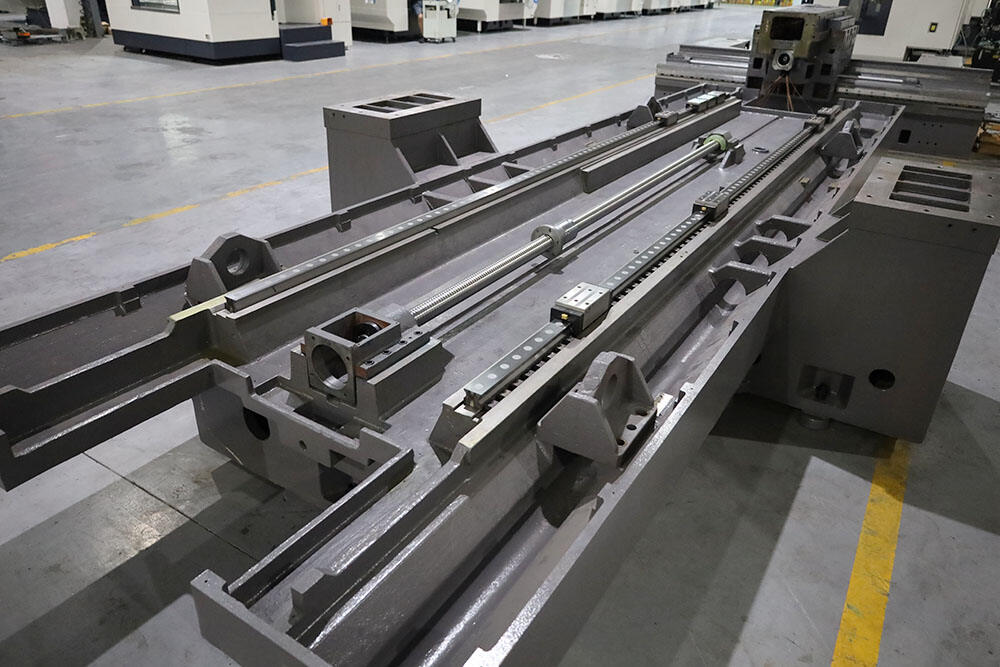
Why Gantry Machining Centers Excel at Oversized Workpiece Handling
A gantry machining center offers distinct advantages for oversized workpieces by separating workpiece motion from cutting motion. Unlike standard vertical or horizontal machining centers, it moves the gantry and spindle while the workpiece remains stationary—a fundamental design that eliminates key constraints on scale, accuracy, and throughput.
Stationary Table Advantage: Stability, Setup Efficiency, and Reduced Dynamic Error
Keeping the workpiece fixed on a rigid, stationary table removes mass-related inertia that degrades positioning accuracy. When tables must move several tons, acceleration and deceleration forces induce vibrations and structural deflection—errors that gantry systems avoid entirely. These machines routinely support loads exceeding 20 tons without shifting during cutting. Setup is also more efficient: operators fixture large parts directly on the table without recalculating dynamic offsets, and alignment remains consistent across long machining cycles. This stability significantly reduces dynamic errors—especially during high-speed finishing or when using long-reach tools—delivering repeatable micron-level positioning for manufacturers of oversized components.
Scalable Footprint Design: Supporting Workpieces from 3 to 15+ Meters Without Compromising Accessibility
The gantry structure scales naturally to accommodate extreme lengths. By extending guideways on both sides, builders create X-axis machining envelopes ranging from 3 meters to over 15 meters—without proportionally increasing moving mass. The worktable remains a simple, flat surface, so lengthening it adds cost linearly rather than exponentially. Accessibility stays uncompromised: operators walk freely around the stationary part, load tools directly, and inspect features from multiple angles. The open column layout also allows easy crane access for part placement. This scalability makes gantry machining centers the most practical solution for industries processing long sections—such as wind turbine blades, rail car frames, and large mold bases—where moving-table designs become mechanically impractical and prohibitively expensive.
Structural Rigidity and Thermal Stability in Gantry Machining Centers
Monolithic Bridge and Fixed-Column Architecture: Foundations of High Static and Dynamic Stiffness
The core strength of a gantry machining center lies in its fixed-column, monolithic bridge architecture. With the workpiece stationary, the machine frame can be engineered for maximum rigidity—minimizing deflection under heavy cutting forces. Static stiffness values commonly exceed 50 N/µm, while dynamic stiffness—critical for vibration damping during high-speed machining of hard alloys—is enhanced through precision-ground linear guides and preloaded ball screws. This combination ensures positional stability during aggressive material removal on large parts, where even micron-level toolpath deviation compromises dimensional integrity. Research shows such rigid gantry structures reduce dynamic error by over 80% compared to C-frame machines when milling titanium alloys at 15,000 RPM.
Thermal Compensation Integration: Bridging the Gap Between Rigidity and Real-World Accuracy
Structural rigidity provides the foundation—but thermal management ensures sustained precision. Machining generates heat, causing expansion in critical components like ballscrews and spindle housings. Modern gantry machining centers integrate multi-point temperature sensors with predictive compensation algorithms that monitor thermal growth in real time and adjust axis positioning accordingly. For example, a 1°C temperature gradient across a 10-meter axis can induce up to 120 µm of error in untreated steel. By applying compensation models, advanced systems maintain accuracy within ±0.015 mm—even during 24-hour continuous operation—making them indispensable for nuclear component manufacturing, where thermal cycling is unavoidable.
Precision Performance of Gantry Machining Centers Across Critical Industries
Aerospace: Single-Setup Wing Spar Machining with ±0.015 mm Tolerance on 8-Meter Systems
Gantry machining centers deliver unprecedented precision for aerospace components like wing spars exceeding 8 meters. Their monolithic bridge design eliminates cumulative positioning errors common in linear motor-driven systems, while integrated thermal compensation maintains ±0.015 mm positional accuracy throughout extended cycles. This enables single-setup processing of titanium alloy spars—reducing alignment errors by 73% compared to traditional multi-stage methods.
Energy & Heavy Industry: Nuclear Support Ring and Hydro Turbine Component Milling
In energy applications, gantry machining centers mill nuclear reactor support rings weighing over 40 tons with positional accuracy within 0.02 mm/m. The stationary workpiece configuration prevents vibration during critical contouring operations on hydro turbine runners. Five-axis capabilities allow complete machining of Francis turbine blades up to 6 meters in diameter in a single clamping—eliminating reassembly errors historically responsible for 34% of hydraulic efficiency losses.
Frequently Asked Questions
What is the main advantage of using a gantry machining center for oversized workpieces?
The primary advantage is the separation of workpiece motion from cutting motion, which ensures stability, scalability, and reduced dynamic error for oversized components.
How does a stationary table benefit the machining process?
A stationary table eliminates mass-related inertia, reduces vibration, and enables precise positioning during high-speed finishing or long machining cycles.
What industries benefit the most from gantry machining centers?
Industries like aerospace, energy, and heavy manufacturing benefit the most, especially for large, high-precision components such as wing spars, nuclear support rings, and turbine blades.
How do modern gantry systems manage thermal expansion?
They integrate multi-point temperature sensors and predictive compensation algorithms to adjust for thermal growth in real time, maintaining accuracy within ±0.015 mm.

